

How Long to Use Red Light Therapy for Anti-Aging Results
Table of Contents
- Understanding Red Light Therapy for Anti-Aging
- Recommended Frequency and Session Duration for Anti-Aging
- Red Light Therapy Frequency for Face: Step-by-Step Protocol
- How Long Until Red Light Therapy Works for Skin Rejuvenation
- Red Light Therapy Side Effects and Over-Exposure Risks
- Home Device vs. Professional Treatment: Which Delivers Results Faster
- Maintenance Phase Protocols and Long-Term Consistency
- Conclusion
Last Updated: August 7, 2026
Understanding Red Light Therapy for Anti-Aging
Red light therapy is a well-researched non-invasive approach to skin rejuvenation. Specific wavelengths penetrate the skin's dermal layer and trigger cellular repair processes that reverse signs of aging. Unlike topical creams, red light therapy stimulates your skin's internal repair mechanisms.

At Thermo Plunge Recovery Systems, we've worked with athletes and wellness enthusiasts who've integrated red light therapy into their recovery routines and noticed significant improvements in skin texture and elasticity. The connection between cellular energy and visible anti-aging results is direct and measurable.
Success with red light therapy for anti-aging results depends on three foundational concepts: wavelength selection, irradiance levels, and cumulative exposure over time. Each factor determines whether you'll see noticeable improvements.
How Red Light Wavelengths Stimulate Collagen Production
Red light therapy relies on two primary wavelengths: 660 nanometres (visible red) and 850 nanometres (near-infrared). The 660nm wavelength stimulates fibroblast activity in the upper dermal layer. Fibroblasts produce collagen, the structural protein that keeps skin firm and smooth.
The 850nm near-infrared wavelength penetrates deeper, triggering photobiomodulation at the mitochondrial level and increasing ATP (adenosine triphosphate) production. ATP is cellular energy. More ATP means fibroblasts have the metabolic fuel to manufacture new collagen continuously.
Both wavelengths work through the therapeutic window, a range where light energy is absorbed effectively without causing thermal damage. Wavelength precision matters because too short and the light doesn't penetrate deep enough; too long and the energy dissipates without being absorbed.
Photobiomodulation and Cellular Energy at the Dermal Layer
Photobiomodulation is how light energy stimulates cellular function. When red and near-infrared light hits mitochondria in your skin cells, it energises cytochrome c oxidase, an enzyme in the electron transport chain. This boosts ATP synthesis, the cell's primary energy currency.
Higher ATP production has cascading effects: fibroblasts work faster and produce more collagen, cells repair damage more efficiently, and inflammatory responses decrease. The result is visibly smoother skin with reduced fine lines and improved elasticity.
Collagen synthesis takes time. A single session creates a small stimulus; repeated sessions create cumulative effects. Consistency matters more than intensity, a moderate protocol sustained over weeks outperforms aggressive short-term use.
Recommended Frequency and Session Duration for Anti-Aging
How long to use red light therapy for anti-aging results depends on your starting point, device irradiance, and skin type. Most people see visible improvements between 8 and 12 weeks of consistent use.
Optimal Weekly Schedule
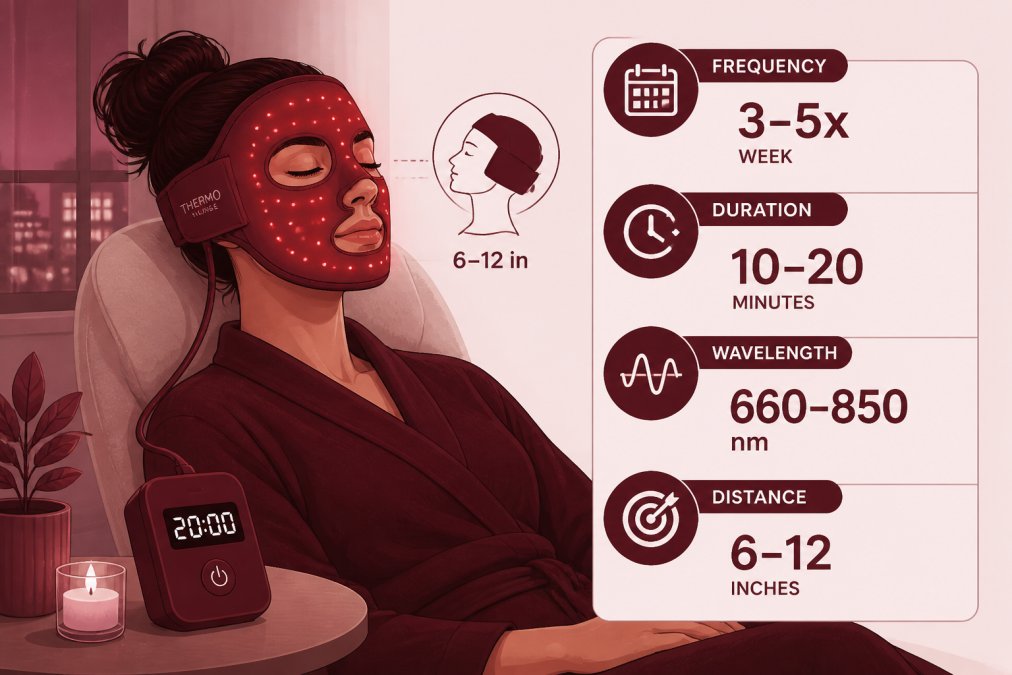
The standard anti-aging protocol calls for 3 to 5 sessions per week. This frequency allows cumulative collagen stimulation without overwhelming your skin's repair capacity. Each session should last between 10 and 20 minutes, depending on your device's irradiance level.
Here's the baseline framework:
- Sessions per week: 3-5 (most people start with 4)
- Duration per session: 10-20 minutes
- Weekly total exposure: 40-100 minutes
- Distance from skin: 6-12 inches (follow your device manual)
- Best timing: Evening, after cleansing, before moisturiser
- Consistency window: Minimum 8 weeks to assess results
Starting with 3 sessions per week is sensible if you're new to red light therapy. After 2-3 weeks, you can increase to 4-5 sessions weekly if you're seeing no adverse reactions.
Adjusting Duration by Irradiance and Skin Type Variations
Irradiance measures light intensity in milliwatts per square centimetre. Higher irradiance means shorter sessions produce the same effect as longer sessions at lower irradiance. The biphasic dose response means there's an optimal therapeutic window, too little light doesn't stimulate collagen production, while too much actually suppresses the response.
If your device delivers high irradiance (above 50 mW/cm²), reduce session duration to 10-12 minutes. Lower irradiance devices (20-40 mW/cm²) require 15-20 minutes. The goal is consistent fluence, the total energy delivered.
Darker skin types may require slightly longer sessions because melanin absorbs some light energy before it reaches the dermal layer. Fair skin types may need shorter sessions to avoid overstimulation. Start conservatively and adjust based on how your skin responds.
Red Light Therapy Frequency for Face: Step-by-Step Protocol
Here's exactly how to structure your red light therapy for anti-aging results.
Starting Your Treatment Protocol
Begin with a baseline assessment. Photograph your face in consistent lighting, morning, after cleansing, before any products. This becomes your reference point for measuring improvements.
Your first week should establish tolerance:
- Day 1-3: Single 10-minute session, 3 times per week (Monday, Wednesday, Friday)
- Day 4-7: Assess for any redness, irritation, or sensitivity
- Week 2: Increase to 15 minutes per session if tolerated well
- Week 3-4: Move to 4 sessions per week, 15 minutes each
- Week 5+: Maintain 4-5 sessions weekly, 15-20 minutes based on irradiance
The Thermo Plunge Recovery Systems Red Light Therapy Pad delivers dual wavelengths (660nm and 850nm) with adjustable timer settings that remove guesswork. The wearable design lets you position it precisely on the face while you work or relax, ensuring consistent placement across sessions.

Measuring Irradiance and Fluence for Consistent Results
Irradiance is power density (milliwatts per square centimetre). Fluence is total energy delivered (joules per square centimetre). Understanding both ensures your sessions are therapeutic.
Your device manual should specify irradiance at a given distance. Maintain consistent distance from your face every session, moving your device 2 inches closer can double the irradiance.
Calculate your fluence: irradiance (mW/cm²) × duration (seconds) ÷ 1,000 = fluence (J/cm²).
For anti-aging, target 2-6 J/cm² per session. This range consistently stimulates collagen production without triggering overstimulation. Most commercial home devices deliver sufficient fluence in 10-20 minute sessions. The key is consistency, same device, same distance, same duration, same time of day.
How Long Until Red Light Therapy Works for Skin Rejuvenation
Timeline for Visible Results
Collagen synthesis takes time as fibroblasts need multiple stimulation cycles to produce enough new collagen to visibly thicken the skin.
Weeks 1-2: No visible change. Skin may feel slightly smoother from increased circulation and cellular activity.
Weeks 3-4: Subtle improvements in skin texture. Fine lines appear slightly less pronounced. Skin tone looks more even.
Weeks 5-8: Noticeable improvements in fine lines around the eyes and mouth. Skin elasticity improves noticeably. Texture becomes smoother.
Weeks 9-12: Significant visible reduction in fine lines. Skin appears firmer and more radiant. Hyperpigmentation spots may fade slightly.
Weeks 13+: Continued improvement as collagen remodelling continues. Some people see ongoing improvements for 6 months before reaching a plateau.
The timeline accelerates if you combine red light therapy with other collagen-supporting habits: adequate sleep, hydration, sun protection, and a diet rich in vitamin C and amino acids.
Biphasic Dose Response and Cumulative Effects
The biphasic dose response explains why "more is better" fails with red light therapy. There's an optimal dose range where collagen stimulation peaks. Below that range, you don't trigger enough response. Above that range, the response actually decreases.
A 10-minute session at moderate irradiance produces better long-term collagen gains than a 40-minute marathon session. Your skin's repair mechanisms work best with consistent, moderate stimulus.
Cumulative effects mean each session builds on the previous one. Your fibroblasts maintain an elevated collagen production state if you maintain consistent frequency. Skip a week and you lose momentum.
Red Light Therapy Side Effects and Over-Exposure Risks
Red light therapy is remarkably safe when used correctly. Serious adverse effects are rare.
Common Side Effects and How to Avoid Them
The most common side effect is temporary redness immediately after treatment from increased blood flow. It typically fades within 30 minutes to 2 hours. If it bothers you, reduce session duration by 5 minutes.
Some people experience mild eye strain if looking directly at the light source. Solution: keep your eyes closed during facial treatments or angle the device slightly away from direct eye contact.
Dry skin is occasionally reported in the first 2-3 weeks because increased cellular activity temporarily increases skin's moisture demands. Use a good moisturiser immediately after treatment. This side effect usually resolves within a week.
Headaches are rare but possible from overuse or incorrect device positioning. If you experience headaches, reduce session frequency to 3 times per week.
Safety Considerations for Consistent Long-Term Use
Over-exposure risks are preventable. Sessions longer than 20 minutes at high irradiance don't accelerate results and risk photobiomodulation fatigue.
Long-term use is safe if you follow the protocol. Studies tracking red light therapy use over 12+ months show no tissue damage, no cumulative toxicity, and no adverse effects from consistent use.
If you have a history of photosensitivity or take photosensitising medications, consult your healthcare provider before starting red light therapy. Pregnancy is not a contraindication, but most practitioners recommend waiting until after the first trimester before starting new treatments.
Home Device vs. Professional Treatment: Which Delivers Results Faster
Professional red light therapy treatments deliver higher irradiance in shorter sessions. A clinical device might deliver 100+ mW/cm² compared to 30-50 mW/cm² for home devices, achieving therapeutic fluence in 5-10 minutes instead of 15-20 minutes.
Professional treatments require travel to a clinic and cost significantly more per session. Home devices cost more upfront but deliver results at a fraction of the per-session cost over time.
Results timeline is similar between home and professional use if you maintain the same frequency and total fluence. The professional option is faster per session but requires more time and money overall.
The Thermo Plunge Recovery Systems Red Light Therapy Pad delivers clinical-grade dual wavelengths (660nm and 850nm) in a wearable format you can use at home. You get professional-quality stimulation without clinic costs or travel time. The 30-day guarantee lets you assess results risk-free before committing long-term.
Maintenance Phase Protocols and Long-Term Consistency
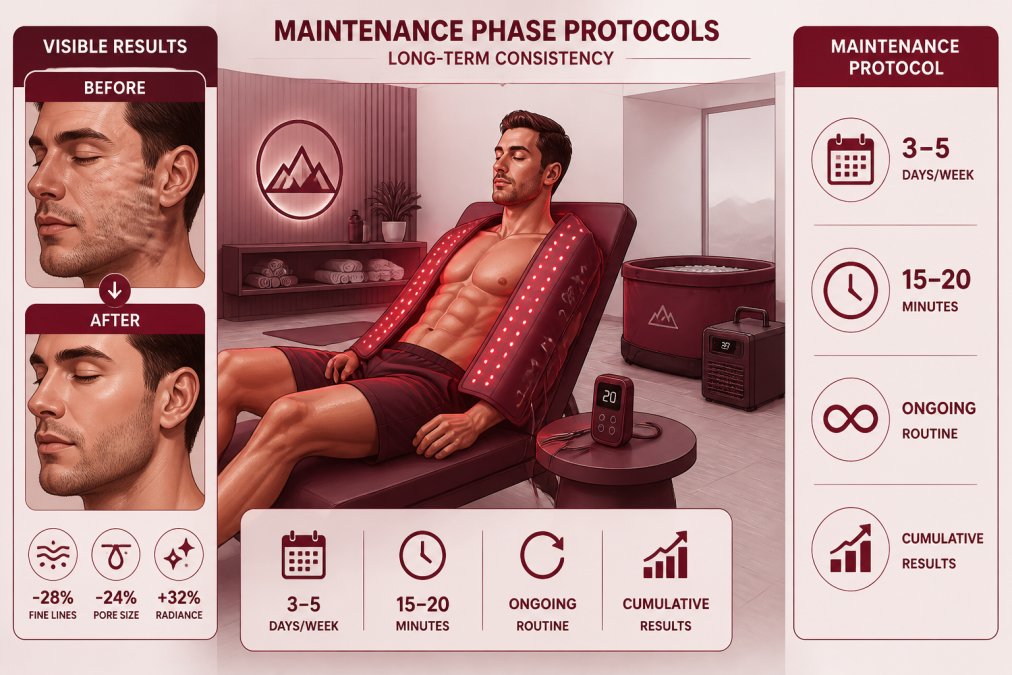
Once you've achieved your anti-aging goals, typically around week 12, you shift from a building phase to a maintenance phase. Maintenance doesn't mean stopping red light therapy, it means reducing frequency enough to sustain collagen levels without continuing to build.
The maintenance protocol looks like this:
Weeks 1-12: 4-5 sessions weekly, 15-20 minutes (building phase) Weeks 13+: 2-3 sessions weekly, 15 minutes (maintenance phase)
Most people find 2-3 sessions weekly is sustainable indefinitely. Seasonal adjustments make sense: winter months might warrant slightly higher frequency, while summer months when UV exposure increases might shift to lower frequency.
Long-term consistency is easier when red light therapy integrates into your existing routine. Use it while you work, read, or relax. The Thermo Plunge Recovery Systems Red Light Therapy Pad's wearable design supports this integration.
Track your results with monthly photographs at the same time of day under consistent lighting. Skin improvements are gradual and easy to miss day-to-day. Monthly photos reveal the cumulative changes that justify the consistency.
Red light therapy for anti-aging works when you understand the science behind how long to use red light therapy for anti-aging results and commit to a realistic protocol. The difference between success and disappointment isn't intensity or fancy equipment, it's consistency, proper irradiance measurement, and patience for collagen remodelling to happen.
If you're ready to integrate professional-grade red light therapy into your recovery routine, Thermo Plunge Recovery Systems offers dual-wavelength devices designed for long-term home use, backed by a 30-day guarantee and 24/7 support. Start with 4 sessions weekly, measure your fluence, and expect visible results by week 8.
Frequently Asked Questions
How many minutes a day should I use red light therapy for anti-aging?
Most anti-aging protocols recommend 10-20 minutes per session, 3-5 times per week. Start at 10 minutes and increase gradually based on your skin's response. The key is consistency rather than duration, a shorter, regular session produces better results than sporadic longer treatments. Irradiance matters too; higher-power devices may require shorter exposure times to achieve the same therapeutic dose.
How long until red light therapy works for wrinkles and fine lines?
Visible skin texture improvements typically appear within 4-6 weeks of consistent use. Fine lines and wrinkles show measurable reduction after 8-12 weeks as fibroblast stimulation increases collagen production in the dermal layer. Full skin rejuvenation benefits, improved elasticity and reduced hyperpigmentation, develop over 3-6 months. Results depend on starting skin condition, treatment frequency, and device irradiance levels.
Can you overdo red light therapy on your face?
Yes. Red light therapy follows a biphasic dose response, too much exposure can reduce efficacy and cause side effects like skin irritation, redness, or temporary hyperpigmentation. Exceeding 20-30 minutes per session or treating more than 5 times weekly increases over-exposure risks. Stick to evidence-based protocols and monitor your skin's response. If irritation occurs, reduce frequency and duration, then gradually rebuild.
Is red light therapy effective for all skin types?
Red light therapy works across most skin types, but skin type variations affect optimal dosage. Darker skin tones may require slightly higher irradiance and longer sessions to achieve the same photobiomodulation effect due to melanin absorption. Fair skin may need shorter sessions to avoid irritation. Consult your device's guidelines for your specific skin tone, and consider starting conservatively to assess tolerance before increasing intensity.
This article was written using GrandRanker