

Ice Bath vs Sauna Blanket for Post Workout Soreness
Table of Contents
- Ice Bath vs Sauna Blanket: How the Two Compare
- Cold Water Immersion and Delayed Onset Muscle Soreness
- Infrared Heat, Circulation, and Muscle Relaxation
- Optimal Duration for Ice Baths and Sauna Sessions
- How to Use a Sauna Blanket for Soreness
- Contrast Therapy Protocols for Athletes
- Risks, Contraindications, and Hypertrophy Interference
- Choosing Your Setup: Ice Bath vs Sauna Blanket at Home
- Frequently Asked Questions
Last Updated: September 16, 2026
Ice Bath vs Sauna Blanket: How the Two Compare
The choice between an ice bath vs sauna blanket for post workout soreness comes down to one question: are you calming acute inflammation, or relaxing muscles that have tightened up? They are two different tools for two different jobs.
Cold water immersion constricts blood vessels and reduces swelling. A sauna blanket raises core body temperature, opens circulation, and loosens tissue. Neither is universally better, the right pick depends on your training load, timeline, and what your soreness feels like.

Below, we break down how each method works, when to use it, and how to build a home setup that fits your space and budget.
Cold Plunge at a Glance
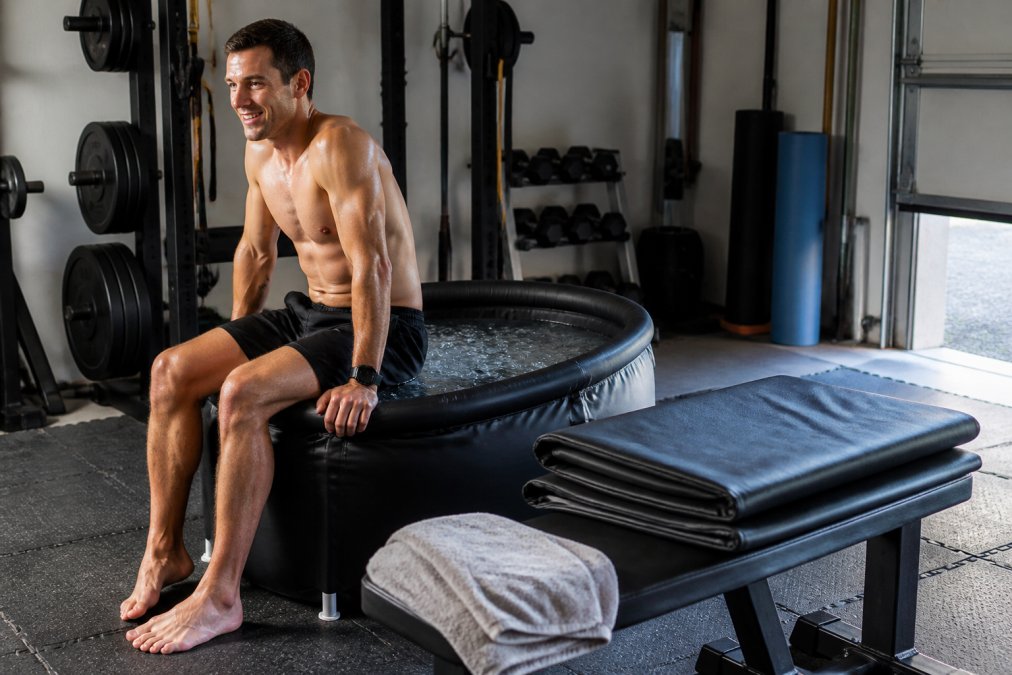
A cold plunge is a tub of water held between roughly 50°F and 59°F that you sit in for a short, timed session. The cold triggers vasoconstriction, narrowing blood vessels and limiting the swelling that follows hard training. When you step out, blood rushes back in, which many athletes find speeds the clearing of metabolic waste.
Sessions run short by design, usually two to ten minutes. Longer is not better here. The Cleveland Clinic overview of cold water therapy notes that cold exposure should be approached gradually, especially for anyone new to it.
The main appeal is speed.
Sauna Blanket at a Glance
A sauna blanket is a heated, insulated wrap you lie inside to raise your body temperature and induce a sweat. Unlike a traditional sauna, it uses direct contact heat, so it takes up almost no floor space and folds away when you're done.
Cold Water Immersion and Delayed Onset Muscle Soreness
For endurance athletes and anyone managing chronic pain, that trade-off matters less. For lifters chasing size, timing is everything.

Infrared Heat, Circulation, and Muscle Relaxation
Infrared heat therapy works on the opposite principle: it increases blood flow rather than restricting it. Warmth dilates blood vessels, improving circulation and helping clear metabolic waste from tired tissue.
Optimal Duration for Ice Baths and Sauna Sessions
The optimal duration for ice baths is two to ten minutes at 50°F to 59°F, while sauna blanket sessions run twenty to sixty minutes at a controlled temperature. Going longer on cold does not improve results and raises the risk of cold-related complications.
| Method | Temperature | Duration | Frequency | Best Timing |
|---|---|---|---|---|
| Ice bath | 50-59°F | 2-10 minutes | 2-4x per week | Post-workout or on rest days |
| Sauna blanket | 104-176°F | 20-60 minutes | 3-5x per week | Evening or post-workout |
| Contrast therapy | Alternating | 1 min cold / 3 min hot | 2-3x per week | After intense sessions |
Why the Numbers Are What They Are
The two-to-ten-minute cold window exists because vasoconstriction peaks within the first few minutes and then plateaus. Staying in longer does not deepen the anti-inflammatory effect; it mainly raises the risk of numbness, shivering, and cold shock. Most practitioners find three to five minutes at 55°F is enough to take the edge off acute soreness without leaving you drained.
Adjusting Duration by Training Type
Endurance athletes recovering from long aerobic sessions often do well with a longer heat session (forty to sixty minutes) because the goal is circulation and parasympathetic reset, not inflammation control. Powerlifters and sprinters, whose soreness is more localized and inflammatory, tend to get more from a short cold plunge (three to five minutes) immediately after training, provided they are not in a hypertrophy block.
Sauna Blanket Mechanics: Why Duration Feels Different
Unlike a traditional sauna, an infrared sauna blanket heats the body through direct contact rather than the surrounding air, so you sweat at a lower ambient temperature and the heat penetrates tissue more directly. A twenty-minute blanket session can feel as intense as a longer traditional sauna, so it is easy to overdo it if you are used to dry saunas.
How to Use a Sauna Blanket for Soreness
Using a sauna blanket for soreness is straightforward once you know the sequence: raise tissue temperature gradually, hold it long enough to relax the muscles, then cool down and rehydrate.
- Hydrate first. Drink water before you start. Sweating pulls fluid and electrolytes, and dehydration makes soreness feel worse.
- Set your temperature. Begin around 120°F to 130°F if you are new, then work upward over several sessions.
- Lie down and wrap up. Get full-body coverage so the heat reaches the whole posterior chain, not just your back.
- Hold for 20 to 40 minutes. Shorter for maintenance, longer when you are genuinely tight.
- Cool down slowly. Sit up, let your temperature settle, and stretch while the tissue is warm and pliable.
- Rehydrate and rest. Replace fluids and give the nervous system time to settle into its relaxed state.
Contrast Therapy Protocols for Athletes
Contrast therapy protocols for athletes alternate cold and heat to get the benefits of both. Cold constricts, heat dilates, and the repeated cycle acts like a pump, pushing fresh blood through tired tissue.
Protocol by Training Type
Most contrast therapy advice stops at the generic protocol, but endurance athletes and powerlifters need different sequences because their soreness and recovery goals differ.
The Mechanism Behind the Pump
The alternation between vasoconstriction and vasodilation creates a mechanical flushing effect. Cold pushes blood away from the surface; heat brings it back. Repeated cycles move fluid through tissue and may help clear metabolic byproducts. This is why contrast therapy often feels more refreshing than either modality alone, even though the evidence for faster recovery is mixed.
Practical Setup at Home
A cold plunge tub and a sauna blanket are the easiest way to run contrast therapy at home because both are compact and can be used in sequence without leaving the room. Set the blanket to 130°F to 150°F for the heat phase, and keep the plunge between 50°F and 59°F. Have a towel and water within reach, and do not exceed twenty minutes total.
Risks, Contraindications, and Hypertrophy Interference
Both methods carry real risks that are easy to overlook when chasing faster recovery. Cold exposure can cause cardiovascular strain, and heat can push core body temperature to unsafe levels if you ignore the signals.
Choosing Your Setup: Ice Bath vs Sauna Blanket at Home
Choosing between an ice bath vs sauna blanket at home comes down to space, budget, and what your soreness actually needs. A cold plunge tub takes up floor space and requires water management. A sauna blanket folds into a closet and needs nothing but an outlet.
Frequently Asked Questions
Is an ice bath or sauna blanket better for muscle soreness?
It depends on what kind of soreness you have. A cold plunge narrows blood vessels and calms acute inflammation right after a hard session, which suits swollen, hot muscles. An infrared sauna blanket raises tissue temperature and relaxes tight, stiff muscles, which suits soreness that lingers a day or two later. Many athletes keep both tools and choose based on how the muscle feels.
How does cold therapy compare to heat therapy for inflammation?
Cold therapy triggers vasoconstriction, which limits blood flow and swelling in the hours right after tissue stress. Heat therapy does the opposite, driving vasodilation and improving circulation so metabolic waste clears and muscles relax. For acute injury management, cold is the first move. For chronic pain relief and general stiffness, heat tends to feel better and supports tissue repair over time.
Can you use an ice bath and a sauna blanket in the same recovery session?
Yes, and that combination is the basis of contrast therapy. A common structure is 3 to 4 minutes of cold followed by 10 to 15 minutes of heat, repeated for 2 to 3 rounds. The shift between vasoconstriction and vasodilation drives blood flow regulation and can leave you feeling looser than either method alone. Keep total session time under about 45 minutes.
How long should you stay in an ice bath versus a sauna blanket?
Most athletes stay in an ice bath for a recommended duration at a specific temperature range. A sauna blanket session usually runs for a comfortable duration at a controlled heat setting, though the infrared model from Thermo Plunge Recovery Systems has a 20 to 60 minute timer you can adjust. Start at the short end of each range and build up as your tolerance improves.
What are the main benefits of infrared sauna blankets for athletes?
Infrared sauna blankets deliver deep tissue heat that promotes relaxation, improves circulation, and supports natural detoxification. For athletes, that translates to looser muscles, less stiffness the day after training, and a shift toward the parasympathetic nervous system that helps with sleep and stress relief. They are compact, foldable, and easy to use at home, which makes consistent recovery easier to maintain.
Recovery is not about doing more; it is about doing the right thing at the right time. Whether you need the sharp anti-inflammatory effect of cold or the deep relaxation of heat, Thermo Plunge Recovery Systems has a home setup that fits. Explore the portable ice bath tub and the infrared sauna blanket, take advantage of free shipping and the 30-day guarantee, and recover smarter starting today.