

Is Hydrogen Peroxide Safe for Ice Baths? 2026 Review
Table of Contents
- The Verdict: Hydrogen Peroxide Is Safe Only at Low Concentrations
- Hydrogen Peroxide Concentration for Cold Plunge: PPM Limits That Matter
- Cold Plunge Water Maintenance: A Step-by-Step Protocol
- How Often to Change Ice Bath Water When Using Peroxide
- Material Compatibility: What Peroxide Does to Liners and Tubs
- Troubleshooting Cloudy Water and Other Common Problems
- Health Contraindications and Safer Alternatives
- Frequently Asked Questions
Last Updated: September 15, 2026
The Verdict: Hydrogen Peroxide Is Safe Only at Low Concentrations
The question of is hydrogen peroxide safe for ice baths has a short answer: yes, at low concentrations, and no, once you push past them.
Hydrogen peroxide (H2O2) is a chemical compound of water and oxygen that breaks down into water and oxygen as it oxidizes contaminants. That by-product profile is why it appeals to plunge owners: no chlorine smell, no bromine residue.
What the Evidence Actually Shows
The evidence supports peroxide as a mild oxidizer, not a sterilizer. It knocks down bacterial load and helps with water clarity, but it does not replace a filtration system or a proper sanitization routine. The CDC guidance on chemical disinfectants is clear that peroxide-based products work best on clean surfaces, not on water already clouded with debris.
When It Crosses the Line
Concentration is the whole game. Most household peroxide is sold at 3%, and that is already stronger than what belongs in a plunge. Food-grade 35% concentration is what you dilute from, never what you pour. Skin irritation, bleaching of liners, and throat irritation from fumes all trace back to over-dosing.
Hydrogen Peroxide Concentration for Cold Plunge: PPM Limits That Matter
The working range for hydrogen peroxide concentration for cold plunge use sits at roughly 50 to 100 parts per million (ppm), maintained between sessions. Above that, you are treating the water more aggressively than the tub or your skin needs.

Dilution ratio matters more than the bottle you buy. A small volume of 35% peroxide goes a long way. Use a graduated container, add peroxide to water (never water to peroxide), and stir before testing.
Food-Grade vs. Technical-Grade: What to Buy
Food-grade peroxide is manufactured to a purity standard that makes it suitable for contact with water you soak in. Technical-grade peroxide can carry stabilizers and trace contaminants you do not want in a plunge. The price difference is small; the risk difference is not.
| Grade | Typical Use | Safe for Plunge Water? | Notes |
|---|---|---|---|
| Food-grade 35% | Diluted for water treatment | Yes, when diluted | Purity standard, no harsh stabilizers |
| Household 3% | First aid, cleaning | Only in small amounts | Weak, easy to over-pour |
| Technical-grade | Industrial bleaching | No | May contain stabilizers |
Cold Plunge Water Maintenance: A Step-by-Step Protocol
A repeatable protocol beats guesswork. Follow these steps each time you service the tub, and log the readings so you can spot drift before the water turns.
- Drain and rinse the tub if the water is more than a week old or visibly cloudy.
- Fill with fresh water and check pH balance; aim for a neutral range.
- Add diluted food-grade peroxide to reach 50-100 ppm. Never pour concentrate directly in.
- Run the filtration system for at least 30 minutes to circulate.
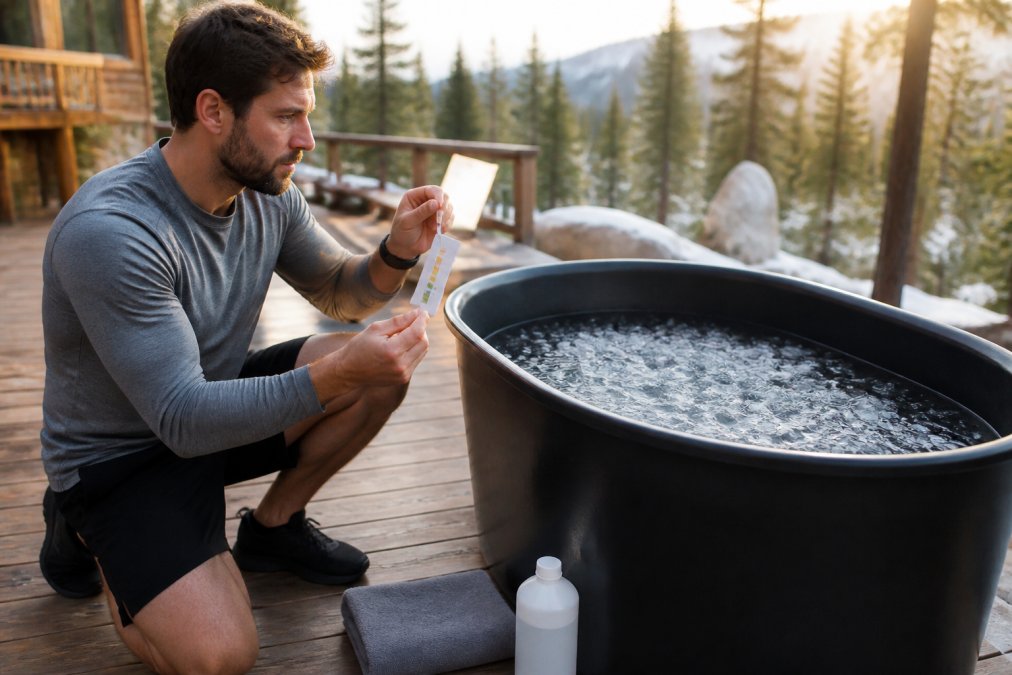
- Test with test strips and record the reading.
- Cover the tub with an insulated lid between sessions.
- Re-test before each soak and top up as needed.
Testing and Validation
Testing is the step most owners skip, and it is the one that separates a clean tub from a science experiment. Use test strips formulated for peroxide, not generic pool strips. If your reading is below target, add diluted peroxide in small increments and re-test. If it is above target, dilute with fresh water. Validation is not optional; it is the only way to know what you are soaking in.
How Often to Change Ice Bath Water When Using Peroxide
How often to change ice bath water depends on use, not the calendar. A tub used daily by one person needs a full change roughly every one to two weeks. A tub used a few times a week can stretch longer if ppm and pH stay in range.

Peroxide slows bacterial growth; it does not stop it. Body oils, sweat, and sunscreen accumulate regardless of chemistry. When water clarity drops, when the smell turns, or when ppm will not hold after topping up, change the water.
Material Compatibility: What Peroxide Does to Liners and Tubs
Not every tub tolerates peroxide equally, and the difference comes down to polymer chemistry. Hydrogen peroxide is an oxidizer, which means it attacks the carbon-hydrogen bonds in organic materials. The more porous and less cross-linked a material is, the faster it degrades.
Material-by-Material Breakdown
| Material | Peroxide Tolerance | Mechanism | Watch For |
|---|---|---|---|
| Acrylic (PMMA) | High | Cross-linked, non-porous surface resists oxidation | Clouding only after prolonged over-dosing |
| Stainless steel (304/316) | High | Passive chromium oxide layer reforms | Pitting if chloride levels are also high |
| Multi-layered PVC | Moderate to high | Plasticizers can leach with repeated exposure | Stiffening, colour shift at seams |
| Inflatable PVC (single-layer) | Low to moderate | Thin walls, high plasticizer content | Seam separation, bubbling |
| Natural rubber | Low | Double bonds in polymer chain oxidize readily | Cracking, tackiness, loss of elasticity |
| EVA foam | Low | Open-cell structure absorbs and degrades | Crumbling, loss of shape |
| Silicone | High | Inorganic backbone resists oxidation | Minimal, generally stable |
| Thermoplastic polyurethane (TPU) | Moderate | Ester linkages can hydrolyze and oxidize | Surface hazing, reduced flexibility |
Why the Mechanism Matters
Oxidation in polymers shows up as chain scission, the long molecular chains break into shorter ones. In practice, that means a liner that felt supple in month one feels stiff by month six. Seams are the first failure point because they concentrate stress. If you see fine cracks radiating from a seam, oxidation is already underway.
The Patch Test Protocol
If you are unsure what your tub is made of, test a small, hidden patch first. Dilute a tiny amount of peroxide to your target ppm, apply it to a 1-inch square, and check after 24 hours. Look for colour change, surface tackiness, or a chalky residue. A tub built for repeated chemical exposure, like our material safety guidance from OSHA-aligned handling standards suggest, will hold up far better than a bargain inflatable.
Temperature Accelerates Everything
Cold plunge water is, by definition, cold, but the peroxide you store and dilute is often at room temperature.
Match your sanitizer to your tub material before you match it to your routine. A liner that fails early costs more than the peroxide you saved.
Troubleshooting Cloudy Water and Other Common Problems
Health Contraindications and Safer Alternatives
Who Should Avoid Peroxide-Treated Plunge Water
The pH Connection
Safer Alternatives
When to Skip the Soak Entirely
Frequently Asked Questions
Is it safe to add hydrogen peroxide to a cold plunge?
Yes, at low concentrations. Most cold plunge owners use food-grade hydrogen peroxide diluted to 50-100 ppm in the tub water. At that level it breaks down into water and oxygen, leaving no toxic residue. Never pour undiluted 35% concentration directly into your tub. Always dilute first, test with strips, and keep the total concentration below 100 ppm to avoid skin irritation during a 10-15 minute soak.
What chemicals should I put in my ice bath?
Hydrogen peroxide is one option, but it is not the only one. Many cold plunge owners use a combination of a small amount of chlorine or bromine, plus regular filtration and water changes. Hydrogen peroxide works well for cold plunge water maintenance because it oxidizes organic matter without leaving strong odours. If you prefer to avoid chlorine entirely, food-grade peroxide at 50-100 ppm paired with a filter and monthly water changes is a practical routine.
How often should I change the water in my ice bath if I use hydrogen peroxide?
With consistent peroxide dosing and filtration, most owners change ice bath water every 2-4 weeks. If you plunge daily and share the tub, change it every 1-2 weeks. Signs it is time for a change include cloudy water, a slippery film on the liner, or a peroxide test strip reading that drops below 20 ppm within a day of dosing. Always drain, scrub, and refill rather than trying to shock a neglected tub back to clear.
Are there safer alternatives to hydrogen peroxide for cold plunge sanitization?
Yes. Chlorine and bromine are the most common alternatives and are well understood for water hygiene. Some owners use UV or ozone filtration systems that sanitize without added chemicals. Each option has trade-offs: chlorine is effective but can irritate skin at high levels, UV systems add upfront cost, and peroxide requires more frequent testing. The safest choice depends on your tub material, how often you plunge, and whether you share the tub with others.
What happens if I put too much hydrogen peroxide in my bath?
Exceeding 100 ppm can cause skin irritation, redness, and itching, especially during longer soaks. At very high concentrations, peroxide can also degrade rubber seals, vinyl liners, and some inflatable tub materials faster than normal. If you accidentally over-dose, drain part of the water and refill with fresh water, then retest before your next plunge. Keep a test strip kit on hand so you can catch concentration spikes before they affect your skin or your tub.
Keeping a cold plunge clean is a discipline, not a one-time purchase. Peroxide works when you respect the concentration, test every batch, and match your sanitizer to your tub material. Thermo Plunge Recovery Systems builds recovery equipment for athletes and home wellness owners who want professional-grade gear without the guesswork, backed by free shipping, a 30-day guarantee, and 24/7 support. Shop Thermo Plunge Recovery Systems and recover smarter, one clean soak at a time.