

Which Red Light Wavelength Is Best for Collagen?
Last Updated: November 1, 2026
Quick Summary
The best red light wavelength for collagen depends on the target: visible red light, around 630 to 670 nanometers, is absorbed closer to the surface, while near-infrared, around 810 to 850 nanometers, reaches deeper. No single wavelength is proven best for collagen, so the right choice depends on your goals.
- Visible red light sits around 630 to 670 nanometers and is linked with surface skin layers.
- Near-infrared light sits around 810 to 850 nanometers and is often described as reaching deeper.
- A combined 660 nm and 850 nm approach covers both surface and deeper targets in one session.
- Ask sellers for irradiance figures at a stated distance before comparing devices fairly.
- Expect gradual changes over several weeks of consistent use, not immediate results.
Table of Contents
- How Red Light Therapy May Support Collagen and Elastin
- Red Light Therapy Wavelength for Skin: Visible Red vs. Near-Infrared
- Red vs. Near-Infrared Light for Skin: Which Band Targets Collagen
- Irradiance, Dose, and Treatment Distance
- Red Light Therapy Treatment Time and Session Frequency
- How to Choose a Red Light Therapy Device for Collagen
- Safety, Eye Protection, and Realistic Expectations for Your Next Step
- Frequently Asked Questions
How Red Light Therapy May Support Collagen and Elastin
Red light therapy is a non-invasive approach that uses light in the red and near-infrared range to influence skin cells, and the red light wavelength chosen shapes how the light interacts with the skin. Researchers often describe this process as photobiomodulation. The idea is that specific wavelengths get absorbed by cells, which may then change how they behave.
Collagen and elastin are the proteins that give skin its structure and bounce. As we age, production of both tends to slow. That is why many people look at red light therapy when they want firmer-looking skin.
It is worth being clear about the evidence. Many studies are small, use different devices, and measure different outcomes. Some show promising changes in skin appearance, while others are inconclusive. A common approach is to treat red light as a supportive tool, not a guaranteed fix.
The most useful question is not whether red light works. It is which wavelength, dose, and routine make sense for your goals.
Red Light Therapy Wavelength for Skin: Visible Red vs. Near-Infrared
Most red light devices fall into two groups. Visible red light sits around 630 to 670 nanometers. Near-infrared light sits around 810 to 850 nanometers. You cannot see near-infrared, but it is still active in the skin.
The red light wavelength in the visible band is typically linked with the surface layers of the skin, including the epidermis and upper dermis. Many people use it for concerns like fine lines and overall skin tone. Near-infrared is often described as reaching somewhat deeper.
Watch out: a device that lists only "red light" may not tell you the wavelength. Check the product specs before you buy.
National Institutes of Health overview of low-level light therapy
How Wavelength Relates to Skin Penetration Depth
Penetration depth depends on how light interacts with tissue. Shorter wavelengths tend to be absorbed closer to the surface. Longer near-infrared wavelengths tend to travel further before being absorbed.
This matters because collagen-producing cells sit in the dermis, below the surface. Light that reaches that layer may have a different effect than light that stays near the top.
Still, penetration is only one factor. The amount of light that actually arrives matters just as much.
Red vs. Near-Infrared Light for Skin: Which Band Targets Collagen
Neither band is a clear winner on its own, and the honest answer is that the "best" wavelength depends on what you are trying to reach. What the research supports is a set of trade-offs, not a single champion. Here is how to think about them.
What is reasonably well established: Red and near-infrared light in the ranges used by home devices can be absorbed by cells and influence behaviour through photobiomodulation. Reviews of photobiomodulation and skin describe changes in skin appearance and markers of skin aging in some studies, but the studies vary widely in device, dose, and population. peer-reviewed review of photobiomodulation and skin
What is proposed but less certain: That one band is superior for collagen specifically. Most reviews do not isolate a single wavelength as best for collagen production. Instead, they describe overlapping effects, with visible red often studied for surface skin concerns and near-infrared often studied for deeper targets.
A practical way to compare the two bands for collagen goals:
- Visible red (roughly 630 to 670 nm): Absorbed closer to the surface, so it is often chosen when the goal is the epidermis and upper dermis, fine lines, skin tone, and overall surface appearance. Many users start here because it is well tolerated and easy to self-apply.
- Near-infrared (roughly 810 to 850 nm): Travels further into tissue before being absorbed, so it is often chosen when the goal includes deeper dermal targets. It is invisible, which means you cannot judge output by eye, you need the device specs.
- Both together: A combined 660 nm plus 850 nm approach is common because it covers surface and deeper targets in one session. It is not proof that combining is better; it is a way to avoid choosing blind.
A short decision guide:
- If your main concern is surface texture, tone, and early fine lines, start with visible red around 660 nm.
- If your concern includes deeper firmness or you are treating areas with thicker tissue, consider near-infrared around 850 nm.
- If you want one device for both, look for a dual-wavelength unit with stated irradiance at a stated distance.
- If a seller cannot tell you the wavelength in nanometres, treat that as a reason to keep looking.
Irradiance, Dose, and Treatment Distance
Wavelength is only part of the picture. Irradiance is the amount of light energy delivered per square centimeter per second. Dose is the total energy delivered over a session. Distance from the device also changes how much light reaches the skin.
If a device is too far away, the irradiance drops. If it is too close, heat can become a concern. Following the manufacturer's distance guidance is the simplest rule.
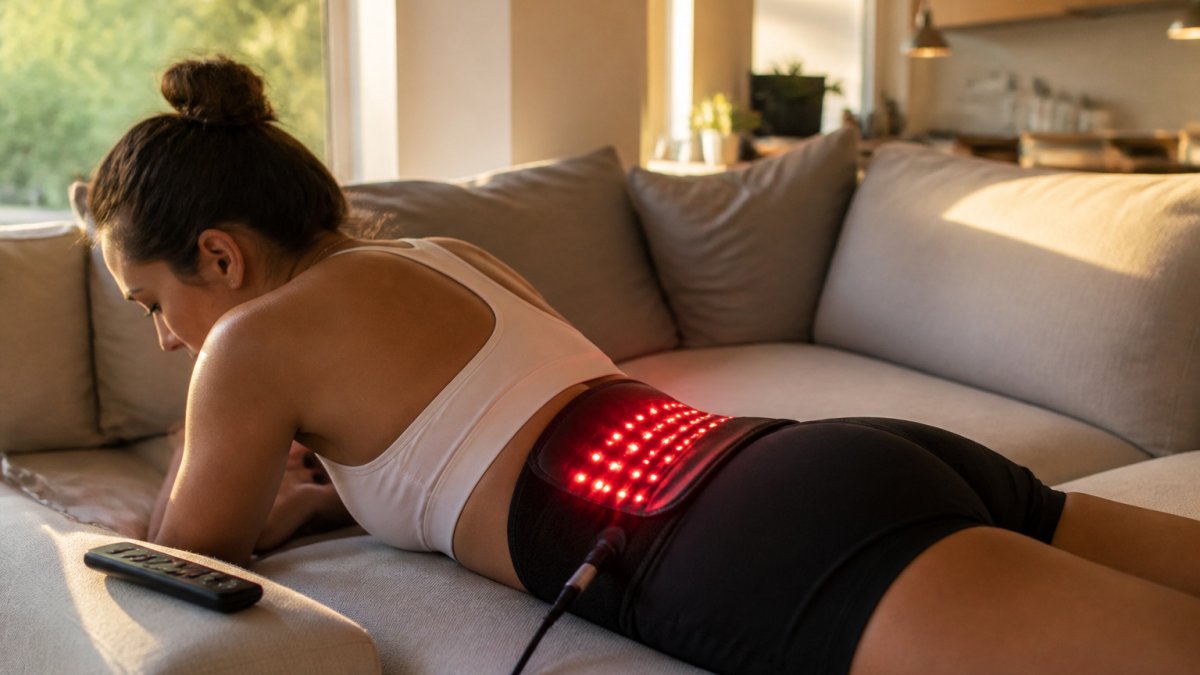
Red Light Therapy Pad – Full-Body Infrared Healing Wrap →
Ask any seller for irradiance figures at a stated distance. Without those numbers, it is hard to compare devices fairly.
Red Light Therapy Treatment Time and Session Frequency
Session length varies by device and wavelength. Many home devices recommend sessions of several minutes to around twenty minutes. Always follow the instructions that come with your device.
Consistency usually matters more than long single sessions. Most people use red light several times per week over a period of weeks before judging results. Skin changes, if they happen, tend to be gradual.
- Start with the shortest recommended session
- Use a timer so you do not overdo it
- Track your routine for at least several weeks
- Take photos in the same light to compare progress
How to Choose a Red Light Therapy Device for Collagen
Most buying guides list the same features. The gap is that few explain how to interpret them, which is where readers get stuck. A device can list a wavelength and still deliver very different treatment depending on irradiance, distance, and coverage. Use the framework below to compare devices on paper before you buy.
1. Wavelength in nanometres, not marketing language. Look for a stated number, ideally covering both red and near-infrared. "Red light" alone is not a specification. If the listing says 660 nm and 850 nm, you know what you are getting.
2. Irradiance at a stated distance. Irradiance is the amount of light energy delivered per square centimetre per second, and it drops sharply as distance increases. A device with high irradiance at contact may deliver far less at the distance you actually use it. Ask for irradiance figures at a stated distance, and compare like with like.
3. Dose and session time. Dose is the total energy delivered over a session, and it depends on irradiance multiplied by time. This is why session length recommendations vary so much between devices. A short session with a high-irradiance device and a long session with a low-irradiance device can deliver very different doses. Follow the manufacturer's guidance, and do not assume more time is better.
4. Coverage area and fit. A device that covers the full target zone in one session is easier to use consistently than one that requires repositioning. Consistency matters more than any single session.
5. Evidence quality behind the claims. Separate what is clinically studied from what is proposed. Many devices cite photobiomodulation research generally, but that research may use different wavelengths, doses, and populations than the device in front of you. A seller who distinguishes evidence from marketing is usually a better signal than one who does not.
6. Safety features and instructions. Look for clear guidance on eye protection, treatment distance, session limits, and contraindications. The FDA regulates light-based devices, and clear labelling is part of responsible design. U.S. Food and Drug Administration guidance on light-based devices
Our wrap uses dual wavelengths at 660 nm and 850 nm, with a 71 by 31 inch coverage area, an adjustable timer, and a remote.
For a step-by-step routine, read our guide on 5 Steps to Combine Red Light Therapy With Your Skincare.
Safety, Eye Protection, and Realistic Expectations for Your Next Step
Red light is generally considered low risk, but safety still matters. Protect your eyes as your device instructions recommend, especially with near-infrared. Avoid use over areas with active infection or open wounds unless a clinician advises it. If you are pregnant, have a light-sensitive condition, or take medication that increases light sensitivity, speak with your doctor first.
Set realistic expectations. Changes in skin appearance, if they occur, tend to take weeks or months. Treat red light as one part of a broader skin routine that includes sun protection, sleep, and good skincare habits.
If you are concerned about sensitive skin, our guide on safe red light therapy covers the precautions in more detail.
Frequently Asked Questions
What wavelength of red light is best for collagen production?
Most of the research and product literature discussed for collagen focuses on visible red light in the roughly 630 to 670 nm range, with near-infrared around 810 to 850 nm also commonly studied. Visible red is usually linked to skin-level concerns such as fine lines and skin tone, while near-infrared reaches deeper tissue. No single wavelength has been proven superior for collagen in humans, so the evidence is best described as promising but still limited. Choosing a device that lists its specific wavelengths, and ideally both red and near-infrared, gives you the most flexibility.
Is red or near-infrared light better for collagen?
Neither is proven better in every case. Visible red light, around 630 to 670 nm, acts mainly on the epidermis and upper dermis, where most collagen-related skin changes are measured. Near-infrared light, around 810 to 850 nm, penetrates deeper and is often used for tissue below the skin surface. Many people combine both bands, as in a dual-wavelength pad, but the research has not settled which combination gives the strongest collagen response.
How long does it take to see results from red light therapy?
Results vary and are not well documented in controlled studies. Most protocols discussed in the literature run for several weeks to a few months at a consistent frequency before any change in skin appearance is evaluated. Session length commonly falls in the range of about 10 to 20 minutes, and consistency matters more than any single long session. Keep a dated photo log and measure changes over at least 8 to 12 weeks.
Can you use red light therapy every day?
Many devices are designed for daily use, and many protocols use sessions several times a week. Daily use within the manufacturer's stated session time is generally considered low risk for healthy skin, but skin sensitivity varies. Start with shorter sessions, watch for irritation, and follow the device's instructions. If you have a skin condition or take photosensitizing medication, check with a physician before starting.
Thermo Plunge Recovery Systems builds home recovery equipment for athletes and wellness users. If you want a dual-wavelength option for your routine, our Red Light Therapy Pad is a practical place to start.

