

Best Water Filters for Cold Plunge Systems: 2026 Guide
Table of Contents
- Understanding Micron Ratings and Filtration Efficiency
- Pleated vs. Spun Polypropylene Filters for Cold Plunges
- DIY Cold Plunge Filtration Setup: A Step-by-Step Guide
- How to Sanitize Ice Bath Water Without Harsh Chemicals
- Cold Plunge Water Maintenance Tips for Long-Term Clarity
- Flow Rate vs. Chiller Performance: Why GPH Matters
- Winterization and Storage for Cold Plunge Filters
- Conclusion
- Frequently Asked Questions
Last Updated: September 19, 2026
Understanding Micron Ratings and Filtration Efficiency
Micron rating is the most important specification when comparing the best water filters for cold plunge systems: it tells you the smallest particle size the filter can capture. A 5-micron filter catches particles down to 5 micrometers; a 20-micron filter lets smaller debris pass through to your pump.

For cold plunge systems, the practical sweet spot sits between 5 and 20 microns. Anything coarser leaves fine particulate matter circulating, which clouds the water and feeds bacterial growth. Anything finer clogs quickly and chokes your flow rate.
Here's what most guides get wrong: they treat micron rating as a quality score, where lower is always better. It isn't. A 1-micron filter on a small pump will restrict circulation so badly that your water turns stagnant. The U.S. Environmental Protection Agency's guidance on drinking water filtration makes the same point for household systems: filter performance depends on matching the cartridge to the flow it has to handle.
Match the rating to your pump's output and your sanitizing method, not to a marketing number.
Pleated vs. Spun Polypropylene Filters for Cold Plunges
Pleated polyester cartridges and spun polypropylene cartridges are the two filter types you'll actually choose between, and they behave very differently.
Pleated cartridges fold a large surface area into a compact housing, which means slower pressure drop and a longer lifespan between cleanings. They're reusable, and a garden-hose rinse restores most capacity. The trade-off: pleated media captures larger debris well but struggles with fine particulate matter and oils unless paired with a finer second stage.
Spun polypropylene cartridges are depth filters, trapping particles throughout the material rather than just on the surface, which makes them better at contaminant reduction in the 5-10 micron range. They clog faster, can't be cleaned as thoroughly, and need replacing more often.
| Filter Type | Best For | Cleaning | Filter Lifespan | Pressure Drop |
|---|---|---|---|---|
| Pleated polyester | Debris removal, pre-filtration | Rinse and reuse | Longer | Lower |
| Spun polypropylene | Fine particulate matter | Replace only | Shorter | Higher |
DIY Cold Plunge Filtration Setup: A Step-by-Step Guide
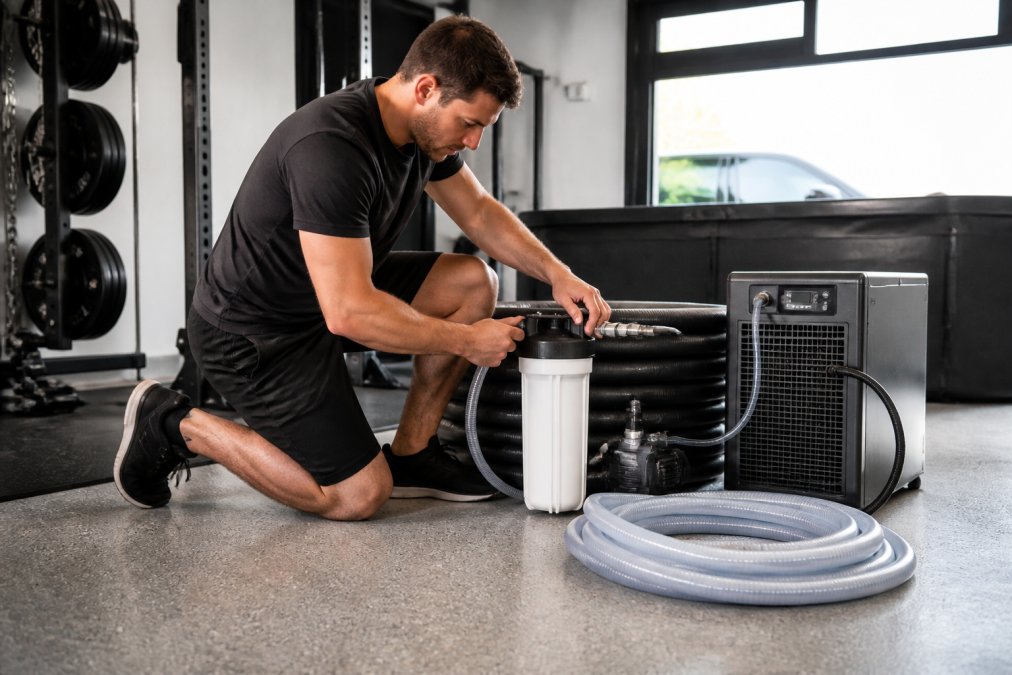
A DIY cold plunge filtration setup is a pump, a filter housing, and hosing connecting them to your tub, arranged so water circulates continuously through the filter. No plumber needed, but you must size components correctly, which means understanding how flow rate, pressure drop, and chemical compatibility interact.
Choosing a Pump and Housing Assembly
Pick your pump by GPH (gallons per hour), not by horsepower. A general rule is to turn over your tub's full volume two to four times per hour. A 100-gallon tub needs a pump rated around 200-400 GPH after accounting for the resistance of the filter and hosing.
Water Chiller – 1/3 HP Ice Bath Cold →
Here's the nuance most guides skip: your filter's micron rating directly affects the flow rate your pump can deliver. A finer filter (5 microns) creates more pressure drop than a coarser one (20 microns). Pair a 1-micron filter with a 300 GPH pump and you might see only 150 GPH at the outlet, not enough to turn over the tub efficiently. Check the filter's pressure drop specification at your target flow rate; if the manufacturer doesn't publish a flow-pressure curve, assume a 10-20% flow loss for a clean 10-inch pleated cartridge and up to 30% for spun polypropylene.
The housing must match your cartridge's dimensions exactly. A universal-fit 10-inch housing takes standard 10-inch cartridges, keeping replacement simple and cheap. Confirm inlet and outlet port sizes before buying, because adapters add friction and cost.
Plumbing Connections and Hosing
Use reinforced, food-grade hosing rated for the temperatures you'll run. Standard garden hose becomes brittle in cold water and will crack at the fittings.
- Connect the pump outlet to the filter housing inlet
- Run the housing outlet back into the tub, positioned to create water circulation
- Use stainless steel hose clamps at every connection
- Check for leaks at full pressure before you fill the tub
A common mistake is routing the return line so it just dumps water in one spot. Angle the return to push water around the tub. Stagnant corners are where biofilm starts.
Chemical Compatibility: The Missing Piece
Most DIY guides ignore water chemistry, but your filter media, hosing, and pump seals all have a pH range they tolerate. Hydrogen peroxide is pH-neutral and safe for all common filter materials. Ozone is compatible with pleated polyester and spun polypropylene but degrades natural rubber seals over time, use silicone or EPDM instead.
If you're running a saltwater system, be aware that chloride ions can attack stainless steel fittings.
How to Sanitize Ice Bath Water Without Harsh Chemicals
Learning how to sanitize ice bath water comes down to three tools: filtration, circulation, and oxidation. Chlorine and bromine work, but many find the smell and skin irritation unpleasant for daily use.
Using an Ozonator for Biofilm Prevention
For a deeper look at water safety standards, the Centers for Disease Control and Prevention's guidance on recreational water illnesses explains how pathogens behave in treated water.
Cold Plunge Water Maintenance Tips for Long-Term Clarity
Cold plunge water maintenance tips that work follow a simple rhythm: test, filter, clean, repeat. Water clarity is a lagging indicator, by the time it looks cloudy, the problem has been building for days.
- Daily: Confirm the pump is running and water is circulating
- Every 2-3 days: Check pH and sanitizer levels
- Weekly: Rinse the pleated cartridge and skim surface debris with a skimmer
- Monthly: Deep clean the cartridge or replace the spun stage
- Every 3-4 months: Drain, scrub the tub, and refill
The Environmental Angle: Reducing Waste
Disposable spun polypropylene cartridges are a significant waste stream in cold plunge maintenance. Switching to a reusable pleated cartridge as your primary filter can reduce waste. Rinse weekly, deep clean monthly with dilute vinegar, and it can last for multiple seasons.
Water Chiller – 1/3 HP Ice Bath Cold →
Flow Rate vs. Chiller Performance: Why GPH Matters
Flow rate and chiller performance are directly linked, and this is the gap most cold plunge content never addresses. A chiller removes heat by passing water across a cold evaporator coil. If water moves too slowly, the chiller can't shed heat fast enough. If it moves too fast, the water doesn't spend enough time in contact with the coil to cool properly.
Flow Rate vs. Chiller Performance: Why GPH Matters
Flow rate and chiller performance are directly linked, and this is the gap most cold plunge content never addresses. A chiller removes heat by passing water across a cold evaporator coil. If water moves too slowly, the chiller can't shed heat fast enough. If it moves too fast, the water doesn't spend enough time in contact with the coil to cool properly.
Winterization and Storage for Cold Plunge Filters
If you're storing your system through a freeze:
- Drain the tub completely
- Disconnect the pump, housing, and all hosing
- Tip each component to drain residual water from low points
- Remove the cartridge and let it dry fully before storing
- Store hosing coiled and indoors, away from direct sunlight
- Bring the pump and chiller indoors
There's an environmental angle here too: a pleated cartridge rinsed and reused for several seasons keeps a stack of disposable spun cartridges out of the waste stream. Reusable media plus a drain-and-refill schedule that stretches refills is the lower-impact way to run a home plunge.
Conclusion
Getting filtration right is the difference between a cold plunge you use daily and one you avoid because the water looks wrong. The variables that matter: micron rating, cartridge type, flow rate, and a maintenance rhythm you'll actually keep.
Frequently Asked Questions
What can I put in my cold plunge to keep water clean?
The most effective approach combines mechanical filtration with sanitation. Use a sediment filter with a 5-20 micron rating to capture particulate matter, then add an ozonator or a small amount of food-grade hydrogen peroxide to control bacteria. Cold plunge filters alone remove debris but do not kill microorganisms. For best results with a cold plunge, pair filtration with regular water changes and a sanitizer approved for your tub material.
Does a cold plunge need a filter?
Yes, if you use the tub regularly. Without cold plunge filters, oils, sweat, and debris accumulate quickly, turning water cloudy and creating biofilm on surfaces. A filter extends water lifespan from a few days to several weeks, reduces cleaning frequency, and helps your chiller run efficiently. For occasional use, you can drain and refill each time, but daily users benefit significantly from a filtration setup.
How often should I replace my cold plunge filter?
Most cold plunge filters last 2-4 weeks with daily use, depending on bather load and water quality. Replace the cartridge when you notice reduced flow rate, discoloration, or persistent cloudiness after sanitation. Pleated polyester filters can sometimes be rinsed and reused once or twice, while spun polypropylene cartridges are typically single-use. Mark your calendar and check pressure drop as a reliable replacement signal.
Can I use a standard pool filter for a cold plunge?
Standard pool filters are usually too large and flow too many gallons per hour for a cold plunge. They also use different plumbing connections. Instead, look for a small in-line filtration system or a universal-fit cartridge designed for cold plunge volumes under 100 gallons. A dedicated cold plunge filter gives you better micron control and fits standard hosing and fittings without adapters.