

Is Red Light Therapy Effective for Acne Scarring?
Quick Summary
Red light therapy may help redness and inflammation linked to acne, and it may improve the look of some marks. Evidence that it fills in deep, pitted acne scars is limited, so results depend heavily on scar type. Most people judge results after several weeks of consistent use, often reassessing around 3 months.
- Identify whether you have active acne, post-acne marks, or true acne scars first.
- Most published research on light therapy for acne measures inflammatory lesion counts, not scar texture.
- Evidence for established atrophic acne scars is thin, with low certainty for home devices.
- Take weekly photos in consistent lighting and rate redness and texture from 1 to 5.
- Reassess at 4 to 8 weeks, then again at 3 months, and see a dermatologist if there is no improvement.
Table of Contents
- What Red Light Therapy Does to Skin
- Acne Scars, Post-Acne Marks and Active Acne: Know Which You Have
- How Strong Is the Evidence for Acne Scarring?
- Red or Blue Light for Acne Scars: What Each Targets
- Red Light Therapy for Acne Scars at Home: A Practical Protocol
- How Long to Use Red Light Therapy for Acne Scars
- Red Light Therapy Acne Scars Before and After: Tracking Real Change
- When to See a Dermatologist Instead of Relying on a Device
- Frequently Asked Questions
What Red Light Therapy Does to Skin
Red light therapy is a non-invasive treatment that uses low-level red and near-infrared light to reach the skin. Researchers often call it photobiomodulation. The idea is that cells absorb certain wavelengths and respond with more energy production and repair activity.
Most home devices use wavelengths in the red range (around 630 to 660 nanometres) and the near-infrared range (around 810 to 850 nanometres). Light at these wavelengths penetrates the upper layers of skin, and some reaches deeper tissue.
The next sections look at what the evidence actually shows.
Acne Scars, Post-Acne Marks and Active Acne: Know Which You Have
Before you judge any treatment, identify what you are treating. Three different problems often get lumped together.
- Active acne: Inflamed pimples, cysts or nodules that are still forming. This is a current breakout.
- Post-acne marks: Flat red or brown spots left after a pimple heals. These are post-inflammatory pigmentation, not scars. They often fade over several months without treatment.
- Acne scars: Permanent changes in skin texture, usually depressions called atrophic scars (ice pick, boxcar and rolling types) or, less often, raised scars.
Red light is most often discussed for active inflammation and for redness. Its evidence for true depressed scars is weaker. If your concern is a flat dark mark, results may look different than if your concern is an indented pit.
Watch out: buying a device for deep, pitted scars and expecting it to fill them in is the most common mismatch. Set expectations by scar type first.
How Strong Is the Evidence for Acne Scarring?
The evidence is uneven, and it depends heavily on what you are measuring. Most published research on light therapy for acne focuses on active inflammatory lesions, not on established scars. That distinction matters because a study showing fewer pimples does not prove that a device will remodel a depressed scar.
A useful way to read the evidence is to separate it into three tiers:
- Active acne studies: Several small randomized and split-face trials have tested red and blue light for inflammatory acne, often reporting reductions in lesion counts over several weeks. These studies typically use professional-grade panels or arrays with disclosed irradiance and treatment schedules. They tell us light can influence inflammation and sebaceous activity, but they do not measure scar texture.
- Post-acne mark studies: Some trials and case series report improvement in post-inflammatory erythema and pigmentation after light-based treatment. These are closer to the scar question but still measure colour and redness, not dermal volume or indentation depth.
- Established scar studies: Research specifically on atrophic acne scars is much thinner. What exists often combines light with other modalities, uses small samples, lacks a sham control, or relies on subjective investigator ratings rather than objective imaging or profilometry. Certainty is low to very low for the claim that home red light devices reliably improve true scars.
Dermatology organizations in the United States, including the American Academy of Dermatology, discuss light-based treatments as options for acne while generally recommending established treatments first. You can read their patient guidance through American Academy of Dermatology acne treatment guidance. The National Institutes of Health also indexes published research on photobiomodulation, which is useful if you want to read the primary studies yourself: National Library of Medicine research on low-level light therapy.
When you read a study, check four things: the sample size, whether there was a control or sham group, the treatment parameters (wavelength, irradiance, session length, frequency), and whether the outcome measured scar texture or only redness and lesion counts. A common pattern is that studies with the strongest scar-specific claims are the smallest and least controlled.
The strength of the evidence depends on which kind of research you look at, as summarised below.
| Evidence tier | What it studies | Certainty for true scars |
|---|---|---|
| Active acne studies | Inflammatory lesion counts | Shows influence on inflammation, not scar texture |
| Post-acne mark studies | Redness and pigmentation | Closer to scars, but no dermal volume measured |
| Established scar studies | Atrophic acne scars | Low to very low for home devices |
Red or Blue Light for Acne Scars: What Each Targets
Red and blue light work differently, and this difference matters for acne.
Some devices combine both wavelengths. A combination device may make sense if you have active breakouts plus marks or scars. If you only want to address scars or redness, a red-light device is usually the more direct choice.
Red Light Therapy for Acne Scars at Home: A Practical Protocol
If you decide to try a device, a cautious, consistent routine gives you the best chance to judge results without wasting months on a device that cannot deliver. This protocol is a framework, not a universal prescription, because no single dosing schedule is proven best for scars.
Before you buy, evaluate the device. Look for a disclosed wavelength, stated irradiance, a treatment area size, and clear safety information including eye protection. Be skeptical of devices that promise scar removal. If you are also treating sun damage, our guide on how to use red light therapy for sun-damaged skin covers how the same device-based routine applies to that concern.
Set up a consistent session.
- Clean the skin and remove makeup and sunscreen before each session.
- Protect your eyes. Use the protective goggles that come with the device, especially with near-infrared light.
- Position the device at the recommended distance from the skin for the full session.
- Follow the manufacturer's session length and frequency, usually 10 to 20 minutes per session. Do not exceed the recommended dose; more is not better and can irritate skin.
- Keep the rest of your routine steady. Change one variable at a time so you can tell what is working.
Track objectively. Take photos in the same light, at the same distance and angle, once a week. Note the scar type and location so you measure the same spot each time. Record redness and texture on a simple 1-to-5 scale. Reassess at 4 to 8 weeks, then again at 3 months. If you see no change in texture or redness after 12 weeks of consistent use, the device is unlikely to deliver more for that concern.
Watch out: buying a device for deep, pitted scars and expecting it to fill them in is the most common mismatch. Set expectations by scar type first, and stop if you develop irritation, blistering, or increased pigmentation.
For the wider routine, read our guide on 5 Steps to Combine Red Light Therapy With Your Skincare. If you have sensitive skin, also review 7 Steps to Safe Red Light Therapy for Sensitive Skin before you start.
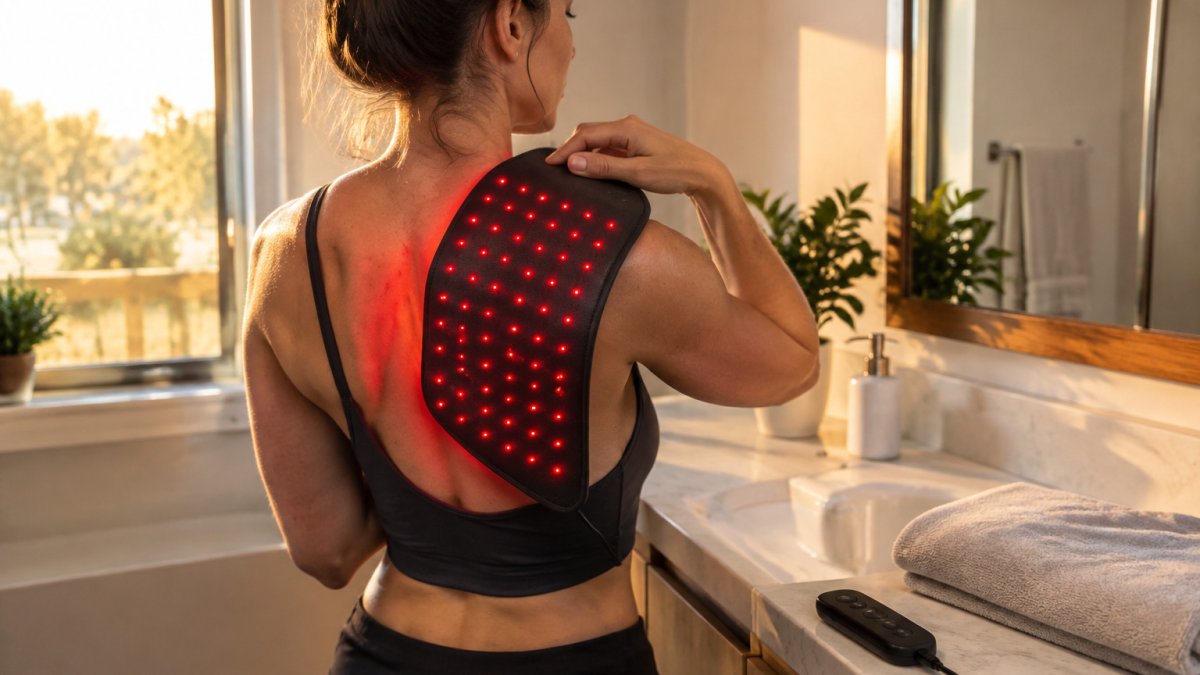
Our Red Light Therapy Pad is one option for people who want a wearable device for larger areas such as the back or shoulders. It has an adjustable timer and a remote control. Learn more at the Red Light Therapy Pad full-body infrared healing wrap listing.

How Long to Use Red Light Therapy for Acne Scars
Timelines vary widely, and no single schedule is proven best for scars.
Many people stop too early. Sessions missed for a week or two break the routine and make it hard to tell whether the device is helping. Track your sessions on a calendar so the pattern is clear.
Session length and frequency should follow the device manufacturer's instructions. Running a device longer or more often than recommended does not speed results and can irritate skin.
Red Light Therapy Acne Scars Before and After: Tracking Real Change
Objective tracking is the most reliable way to see whether red light is working for you.
- Take photos in the same light, at the same distance and angle, once a week.
- Note the scar type and its location, so you measure the same spot each time.
- Record redness and texture in a simple log, rating them from 1 to 5.
- Check at 4 to 8 weeks, then again at 3 months.
Be realistic about before-and-after photos you see online. Lighting, makeup, editing and selective photo choice can all make changes look larger than they are. Your own consistent photos are more trustworthy.
When to See a Dermatologist Instead of Relying on a Device
A device is not the right first step for every situation. Book a visit with a board-certified dermatologist if:
- Your acne is severe, painful, or spreading.
- Your scars are deep, numerous or affecting your confidence.
- You have not improved after several months of consistent treatment.
- You have a skin condition, take medications that increase light sensitivity, or are unsure if a device is safe for you.
A dermatologist can recommend proven options such as topical prescriptions, chemical peels, microneedling or in-office laser treatments, and can combine them with home care.
Last Updated: November 6, 2026
Frequently Asked Questions
Does red light therapy do anything for acne scars?
The evidence base for red light therapy and acne scars is limited, and results vary. Ask a dermatologist whether it fits your situation.
How long does it take for red light therapy to work on acne scars?
Results vary, and consistent use over several weeks is typically needed before judging an outcome. Session length and frequency differ between devices, so follow the manufacturer's instructions and track your progress with photos taken in the same lighting. If you see no visible change after about three months of consistent use, it is reasonable to reassess the approach with a dermatologist.
Is red light therapy safe to use at home for acne scars?
Protect your eyes from bright light, avoid using a device on broken or infected skin, and stop if you notice irritation. People taking photosensitizing medications, or with a history of skin cancer or certain skin conditions, should check with a doctor before starting.
Is red or blue light better for acne scars?
Some devices combine both wavelengths. Neither should be expected to remove an established scar on its own.
