

9 Benefits of Massage Guns for Apartment Living
Quick Summary
Massage guns can help apartment dwellers ease muscle tension and soreness, but the best choice for a shared living space is a quieter model used at low speed. Their benefits are temporary, so they work best as one part of a wider routine that includes movement, stretching and sleep. Pick a device that suits your building and test it before long sessions, since the massage guns apartments need are often the quieter ones.
- Choose a model whose lowest speed setting is quiet enough for shared walls.
- Use short sessions of about 1 to 2 minutes per muscle group, a few times a week.
- Sit on a rug or mat to absorb vibration before it reaches the floor.
- Avoid the neck, spine, joints, bones and any swollen or bruised areas.
- Relief from a massage gun is usually temporary, so keep up movement and sleep.
Table of Contents
- Why Apartment Living Changes How You Choose a Massage Gun
- What Massage Guns Do and How Percussive Therapy Works
- Do Massage Guns Help With Soreness?
- Realistic Benefits for Flexibility, Circulation and Tension
- How Often Should a Massage Gun Be Used in a Small Space?
- Choosing a Quiet Massage Gun for Shared Walls
- Safety Tips for Using a Massage Gun at Home
- Setting Up a Quiet Apartment Routine You Can Keep Up
- Frequently Asked Questions
Why Apartment Living Changes How You Choose a Massage Gun
Apartment living changes how you pick a massage gun. Most product guides assume you have a spare room, a hard floor and no neighbours. This guide is written for people who live in a smaller space, often with shared walls.
The main issues are noise, space and storage. A device that runs loudly can disturb a roommate, a partner or the unit next door. Many people find that a compact, quieter model fits their routine better than the most powerful one on the shelf.
Before you buy, think about where you will use it. A bedroom floor, a living room couch and a bathroom counter each suit a different device. The best massage gun for an apartment is the one you will actually use without disturbing anyone.
What Massage Guns Do and How Percussive Therapy Works
A massage gun is a handheld device that delivers rapid pulses into soft tissue. This method is called percussive therapy. The head moves in and out quickly, and the pulses travel into the muscle beneath the skin.
Most models offer several speeds and interchangeable heads. A flat head covers large muscles like the thighs. A ball or bullet head works better on smaller areas. Using the device for a short session, usually a few minutes per muscle group, is the common approach.
Percussive therapy is a popular way to ease a tight, sore area. Research on how much it changes muscle function is still developing, so treat it as a helpful tool, not a cure.
Do Massage Guns Help With Soreness?
Many people use a massage gun after hard training to ease soreness. Some report that the device makes a sore muscle feel looser for a short time. That relief is usually temporary.
Muscle soreness that appears a day or two after exercise is called delayed-onset muscle soreness. A massage gun may make the area feel better while you use it, but it does not replace rest, hydration or good training habits.
Watch out: pressing hard on a bruise, an injury or a joint can make things worse. If pain is sharp or lasts, see a doctor rather than relying on a massage gun.
Realistic Benefits for Flexibility, Circulation and Tension
Massage guns can offer a few practical benefits. Here is what they can and cannot do:
- Ease tension in large muscle groups for a short time
- Help you feel looser before a workout or stretch
- Support a relaxing wind-down routine after a long day
- Improve how a tight area feels, which may help you move more freely
Massage guns are best thought of as one tool in a wider routine that includes movement, stretching and sleep.
How Often Should a Massage Gun Be Used in a Small Space?
Session length and frequency vary by person. Start slowly and listen to your body.
In a small space, short sessions are easier to fit in. Keep the device on a shelf or in a basket so you can grab it and put it away quickly. Using it while sitting on a couch or bed keeps the setup simple.
Choosing a Quiet Massage Gun for Shared Walls
In an apartment, the sound you hear is only half the problem. If space is tight, you can also compare compact portable ice baths for small apartments.
What to listen and feel for
- Motor type and top speed. Many guns quote a maximum speed in percussions per minute (ppm). The loudest setting is rarely the one you will use indoors. Check the lowest speed instead, since that is your apartment setting.
- Amplitude. This is the stroke length of the head. A longer stroke moves more tissue but also transfers more vibration into whatever the device is pressed against. For shared walls, a mid-range amplitude is usually easier to live with than the largest available.
- Housing and grip. Rubberized or silicone-wrapped handles and heads dampen buzz. Metal-bodied guns can feel premium but often transmit more vibration into your hand and the surface beneath you.
- Weight and balance. A lighter gun is easier to control at low speed, which means less pressing and less vibration transfer.
- Battery and cord. A cordless model with a few hours of rated runtime lets you use it away from walls and outlets, and avoids a cord snagging in tight rooms.
- Attachments. A soft, rounded head is quieter and gentler than a hard bullet or flat head. If quiet matters, start with the softest attachment you have.
How to test before you buy
If a store lets you handle a display unit, run it on the lowest setting and hold it against the sole of your shoe or a hard surface. Listen for a high-pitched whine and feel for a strong tingle in your hand.
Ways to cut disturbance once you own one
- Use the lowest speed that still feels useful, and shorten sessions rather than raising intensity.
- Sit on a rug, a folded blanket or a yoga mat rather than directly on a hard floor. Soft surfaces absorb vibration before it reaches the structure.
- Avoid pressing the device into a wall, door frame or shared structural element.
- Use it on furniture with some give, such as a couch or bed, rather than a rigid chair.
- Keep sessions short and time them considerately; many buildings have quiet hours in the evening and overnight, and a short daytime session is easier to defend than a long late one.
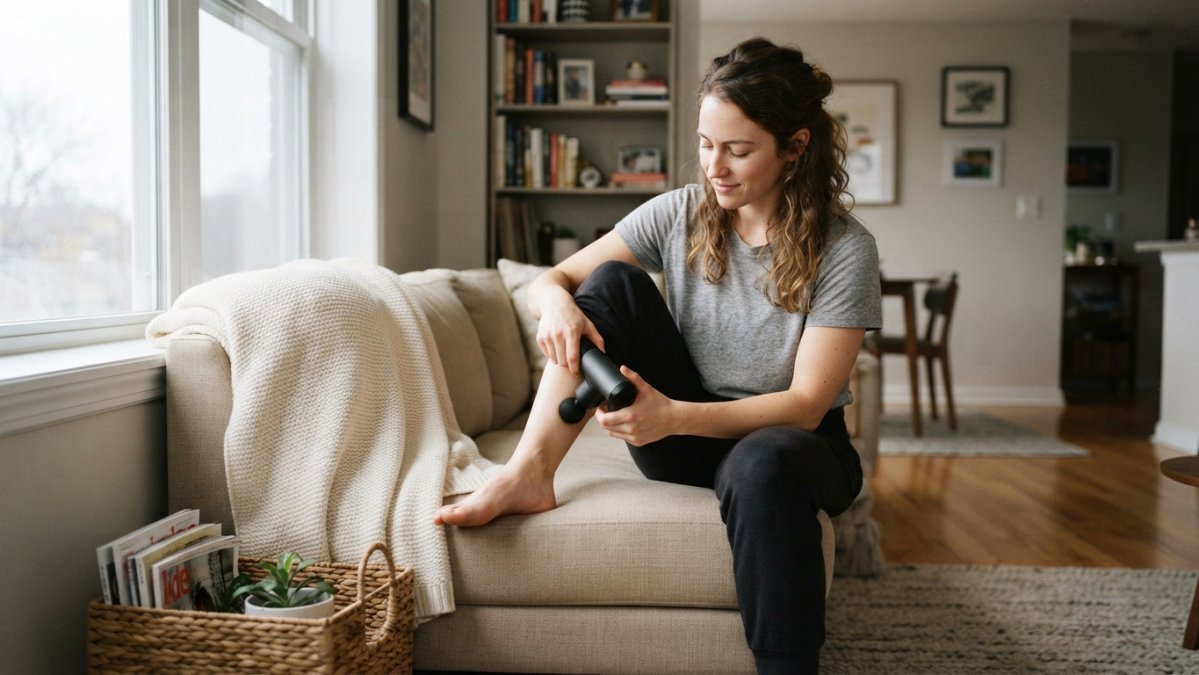
Watch out: a device that feels quiet in your hand can still be audible through a shared floor, so test it briefly at a low setting before committing to a long session.
The article's quiet-buying checks come down to a few specs and what you feel in your hand, so this table lists them for quick scanning.
| Factor | What to check | Why it matters |
|---|---|---|
| Speed | Lowest setting, not the quoted maximum | Your apartment setting is the low end |
| Amplitude | Mid-range stroke length | Long strokes transfer more vibration |
| Housing | Rubber or silicone grip | Dampens buzz |
| Weight | Lighter and balanced | Less pressing, less vibration |
| Attachments | Soft, rounded head | Quieter and gentler |
| Test | Low speed against a shoe | Reveals whine and hand buzz |
Safety Tips for Using a Massage Gun at Home
Safe use matters more in a small home where you may not have much room to recover from a slip. Keep these tips in mind:
- Read the manual and follow the recommended session times
- Avoid the neck, the front of the throat and the spine
- Never use it on bones, joints or areas with swelling
- Stop if you feel numbness, sharp pain or tingling
- Keep the cord and device away from water
If you have a medical condition, are pregnant or take blood thinners, ask a doctor before use.
Setting Up a Quiet Apartment Routine You Can Keep Up
A routine you can repeat in a small space should be short, quiet and easy to start. For a wider look at the recovery gear that suits a home wellness setup, see recovery gear for home wellness setups. The sequence below is a beginner-friendly template, not a prescription.
A 10-minute low-noise session
- Set up (1 minute). Sit on a couch, bed or rug with the device on its lowest speed and a soft attachment fitted. Keep the gun within easy reach and clear the area around you so you do not knock anything over.
- Calves (1 to 2 minutes per leg). Glide the head slowly up and down the calf with light pressure. Let the device do the work rather than pressing hard.
- Thighs (1 to 2 minutes per leg). Move over the large muscle on the front and side of the thigh in slow passes. Keep away from the knee joint itself.
- Glutes (1 minute per side). Use light pressure over the muscle, not the bone.
- Upper back and shoulders (1 to 2 minutes total). Work the muscle around the shoulder blade, avoiding the spine and the neck. Keep pressure light here.
- Wind-down (1 minute). Finish with a few slow stretches for the areas you worked.
Pressure and pace
Start with the weight of the device alone and add only slight pressure. Move the head slowly rather than scrubbing back and forth. If the area feels numb or tingly, you are pressing too hard or staying too long.
How often
Many people use a massage gun for about 1 to 2 minutes per muscle group a few times a week. Daily use is fine for many people, but start with two or three sessions a week and see how you feel. Short, frequent sessions are easier to keep up in a small space than one long session.
Making it stick in an apartment
- Store the gun and its attachments in one basket or drawer so setup takes seconds.
- Pair the session with an existing habit, such as after a shower or while a show is on.
- Keep a folded blanket or mat nearby for vibration damping and comfort. To plan the rest of a compact recovery corner, read home wellness space design ideas.
- Choose a consistent daytime slot so you are not using it during quiet hours.
Watch out: if you live with children, pets or roommates, use the device in a closed room or announce that you are starting, and keep the gun and its small attachments out of reach when not in use.
Your apartment routine should feel easy, not like another chore. Thermo Plunge Recovery Systems offers recovery tools designed for home use, with free shipping, a 30-day guarantee and 24/7 support. Shop the collection to find a setup that fits your space.
Frequently Asked Questions
Are massage guns actually beneficial?
Massage guns can be a useful tool for easing muscle soreness and helping you feel looser before or after a workout. The effects are generally temporary, and research on percussive therapy is still developing. Think of a massage gun as a supplement to stretching, sleep, hydration and rest rather than a replacement for them. If you have an injury, a medical condition or persistent pain, check with a doctor or physical therapist before adding one to your routine.
How can I use a massage gun without disturbing apartment neighbors?
Start with the lowest speed setting and choose a quieter model with a rated noise level, if the manufacturer publishes one. Place a thick rubber mat or folded towel under the device on hard floors to reduce vibration transfer. Avoid using it late at night or early in the morning, and use it on a sofa or carpeted area rather than a wooden floor. Keeping sessions short also limits how long any noise carries through shared walls.
Are massage guns safe to use in a small apartment?
Yes, as long as you store the device safely and use it with care. Keep it away from children and pets, store it on a shelf or in a closet rather than leaving it on the floor, and keep the cord and charging port clear of foot traffic. Make sure there is enough space to hold the device firmly and to move your arm freely. Avoid using it on bruised, swollen or broken skin, and never place it directly on the head, neck or spine.
How often should a massage gun be used?
Most people use a massage gun for a few minutes per muscle group, a few times a week, or after a workout when a specific area feels tight or sore. Pause if you feel numbness, sharp pain or lingering bruising. Start with shorter sessions to see how your body responds, and increase gradually if it feels comfortable.
